

Science fair projects are the ultimate playground for curious minds. They’re not just about gluing popsicle sticks together and hoping for the best. Instead, they’re an exciting opportunity to dive into the world of experimentation and discovery. Whether it’s creating a volcano that erupts with enthusiasm or designing a robot that can fetch snacks, these projects can spark a love for science that lasts a lifetime.
Overview Of Science Fair Projects
Science fair projects serve as an essential avenue for students to explore various scientific concepts while fostering creativity. Projects can cover multiple subjects, including biology, chemistry, physics, and environmental science. These initiatives encourage practical experimentation rather than relying solely on theoretical knowledge.
Students engage in hands-on activities that promote critical thinking skills. By designing experiments, collecting data, and analyzing results, participants develop a deeper understanding of scientific principles. For instance, a project on plant growth may involve varying light conditions to observe their effects.
Different types of science fair projects exist, with each emphasizing unique methodologies. Research-based projects focus on investigating existing scientific theories, while experimental projects entail designing and conducting experiments to test hypotheses. Engineering projects often challenge participants to solve real-world problems through innovative designs.
Participation in science fairs cultivates essential skills that extend beyond classroom learning. Teamwork plays a vital role in collaborative projects, and effective communication becomes necessary when presenting findings. Students build confidence as they share their results with peers, judges, and parents.
Moreover, science fairs enhance students’ problem-solving abilities, as they navigate challenges during their projects. Managing a timeline and adhering to guidelines require organization and discipline. These experiences lay a foundation for future academic pursuits in STEM fields.
Ultimately, engaging in science fair projects inspires curiosity and a lifelong interest in science. Recognizing the value of inquiry-driven learning enriches students’ educational journeys, paving the way for innovation in the future.
Types Of Science Fair Projects
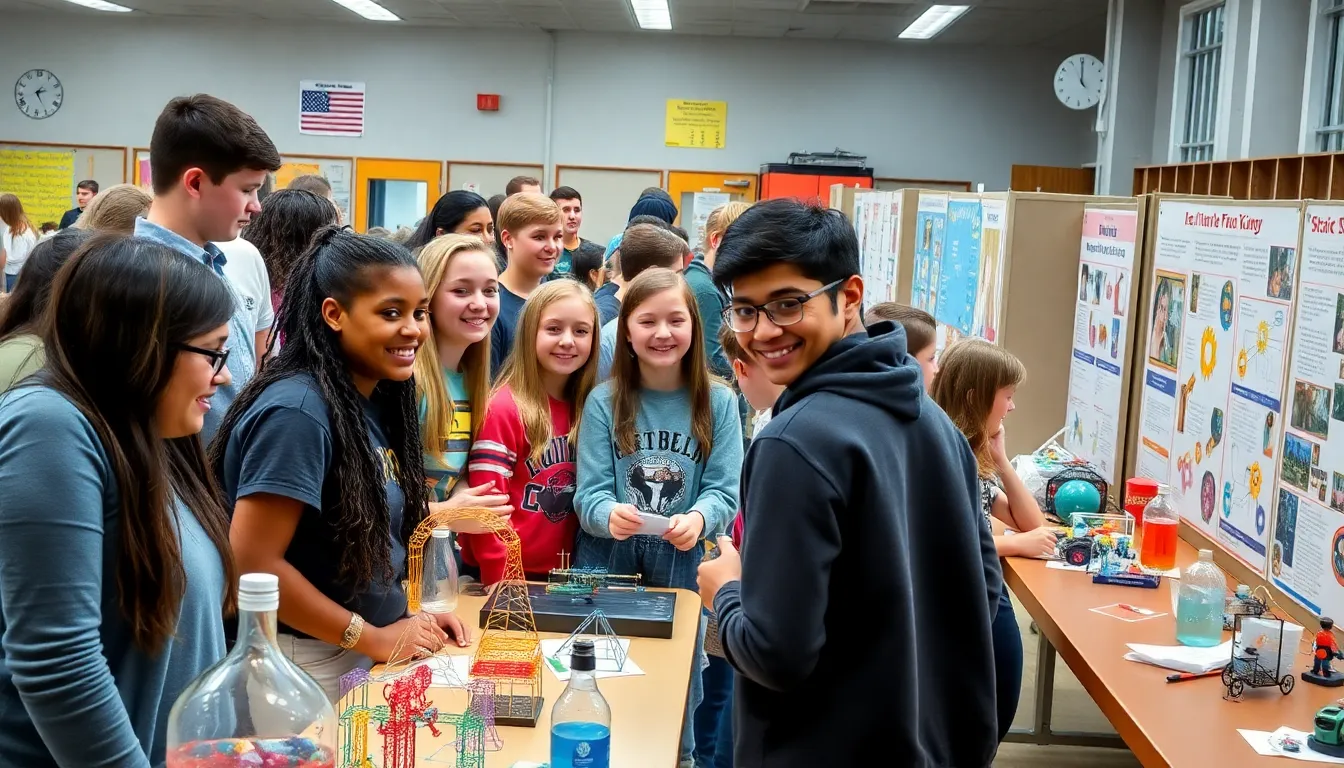
Science fair projects fall into several categories, allowing students to explore diverse scientific concepts. Each type presents unique learning opportunities.
Experimental Projects
Experimental projects focus on conducting tests and trials. Students formulate hypotheses and set up experiments to gather data. For instance, one might measure the effect of light on plant growth, collecting quantitative data over a set period. Results reveal insights into scientific principles as students analyze their findings and draw conclusions. These hands-on experiences build critical thinking skills and familiarize participants with the scientific method.
Research Projects
Research projects involve extensive investigation into a scientific topic. Students collect information from credible sources, such as books and journals, to explore concepts like climate change or renewable energy sources. They then compile their findings into a coherent presentation or report. This process enhances their understanding of scientific literature while developing research skills. Additionally, presenting their research fosters effective communication skills.
Demonstrative Projects
Demonstrative projects aim to illustrate scientific principles visually. Students create models or experiments that showcase processes such as chemical reactions or physical forces. An example includes building a simple circuit to demonstrate electricity flow. These projects enhance comprehension by providing visual representations of complex concepts. Participants learn to explain their demonstrations clearly, further improving their public speaking abilities.
Tips For Choosing The Right Project
Choosing the right science fair project involves understanding interests and considering available resources. Selecting an engaging project ensures enthusiasm throughout the research and execution phases.
Consider Your Interests
Interests often determine project success and enjoyment. Students should examine topics that spark curiosity. Projects like studying ecosystems or experimenting with chemical reactions provide opportunities for meaningful exploration. Choosing a subject they find fascinating helps students stay motivated. Investigating personal hobbies can also inspire innovative ideas. An aligned project strengthens commitment and enhances learning outcomes.
Assess Available Resources
Available resources play a crucial role in project feasibility. Students must evaluate materials, tools, and time when selecting a project. Identifying items on hand eliminates barriers to execution. Utilizing local libraries or online databases enhances research capabilities. Scheduling time for experiments can also prevent conflicts. A clear understanding of what’s accessible allows students to create realistic timelines, ensuring successful completion. Resourcing effectively maximizes creativity and efficiency in project development.
Preparing For The Science Fair
Success hinges on meticulous preparation regarding science fair projects. Structuring projects effectively, along with practice for presentations, significantly enhances outcomes.
Project Design and Planning
Careful project design starts with choosing a relevant topic that resonates with personal interests. Establishing clear objectives directs the research and experimentation process. Creating a timeline keeps progress on track while enabling adequate time for adjustments. Conducting preliminary research allows students to identify methods and materials necessary for success. Documenting procedures and outcomes throughout the project ensures clarity. Collaborating with peers offers additional perspectives, enhancing problem-solving skills. Utilizing available resources efficiently maximizes project potential. Engaging in hands-on experimentation cultivates a deeper understanding of scientific principles.
Presentation Tips
Effective presentations capture attention. Using visuals, such as charts or models, enhances understanding and retention. Practicing speech aloud builds confidence and clarifies complex ideas. Keeping the content structured aids clarity, presenting information in a logical sequence. Engaging the audience through questions or demonstrations fosters interaction. Observing time management during presentations keeps them concise and impactful. Practicing in front of peers allows for constructive feedback, encouraging improvement. Highlighting the significance of findings makes the project memorable.
Common Mistakes To Avoid
Students often make a variety of mistakes when preparing for science fair projects. Failing to choose an appropriate topic ranks as one of the most common errors. Projects should reflect personal interests to maintain enthusiasm throughout the process. Ignoring project guidelines can also lead to disqualification or poor evaluations. Every fair has specific rules about project size and scope that students must follow.
Many students underestimate the importance of research. Gathering reliable data from credible sources is essential for creating a strong foundation for any project. Neglecting documentation during experiments can result in missed observations and incomplete records, hindering analysis. Tracking every step in the scientific process enhances the credibility of findings.
Time management plays a crucial role as well. Procrastination often leads to rushed submissions and incomplete projects. Establishing a clear timeline promotes steady progress and allows ample time for revisions. Additionally, students should avoid overcomplicating experiments. Keeping experiments simple helps focus on critical concepts and reduces the chance of errors.
Presentation also deserves attention. Students frequently overlook the significance of visual aids in their displays. Engaging visuals can capture the audience’s interest and reinforce the project message. Furthermore, not practicing the presentation often results in nerves and unclear communication during the event. Preparing well helps build confidence and clarity.
Understanding these common mistakes enables students to enhance their science fair experiences. By avoiding missteps, they can focus on learning and showcasing their hard work effectively.
Science fair projects are more than just an academic requirement; they’re a gateway to exploration and innovation. By engaging in these hands-on activities, students not only learn scientific principles but also develop critical life skills such as teamwork and effective communication.
Choosing the right project and preparing meticulously can significantly enhance the experience. Students who align their interests with their projects tend to stay motivated and engaged throughout the process.
Avoiding common pitfalls like poor time management and neglecting research ensures a smoother journey. Embracing these challenges ultimately fosters a deeper appreciation for science and paves the way for future academic and career opportunities in STEM fields. With the right approach, science fairs can become memorable milestones in a student’s educational journey.